
🍋 EXPERIMENT 001
Can a Lemon Charge Your Phone?
A real battery, an internet claim, and a little electrical detective work.
Difficulty: Beginner | Cost: Low | Time: 30–60 minutes
THE CLAIM
You've probably seen videos claiming that a lemon, two pieces of metal, and a few wires can charge a cellphone.
But can a lemon actually generate electricity? And if it can, does that mean it can charge your phone?
Let's build one, measure the results, and find out.
WHAT YOU'LL NEED
- 4 fresh lemons
- 4 galvanized nails (zinc-coated)
- 4 pieces of bare copper wire or copper strips
- 5 connecting wires with alligator clips
- Digital multimeter
- Optional: 1,000-ohm resistor for measuring power under load
- Notebook and pencil
Safety: Do not eat the lemons after the experiment. Wash your hands after handling the metals. Do not connect this homemade battery directly to a cellphone or lithium-ion battery.
STEP 1 — BUILD ONE LEMON CELL
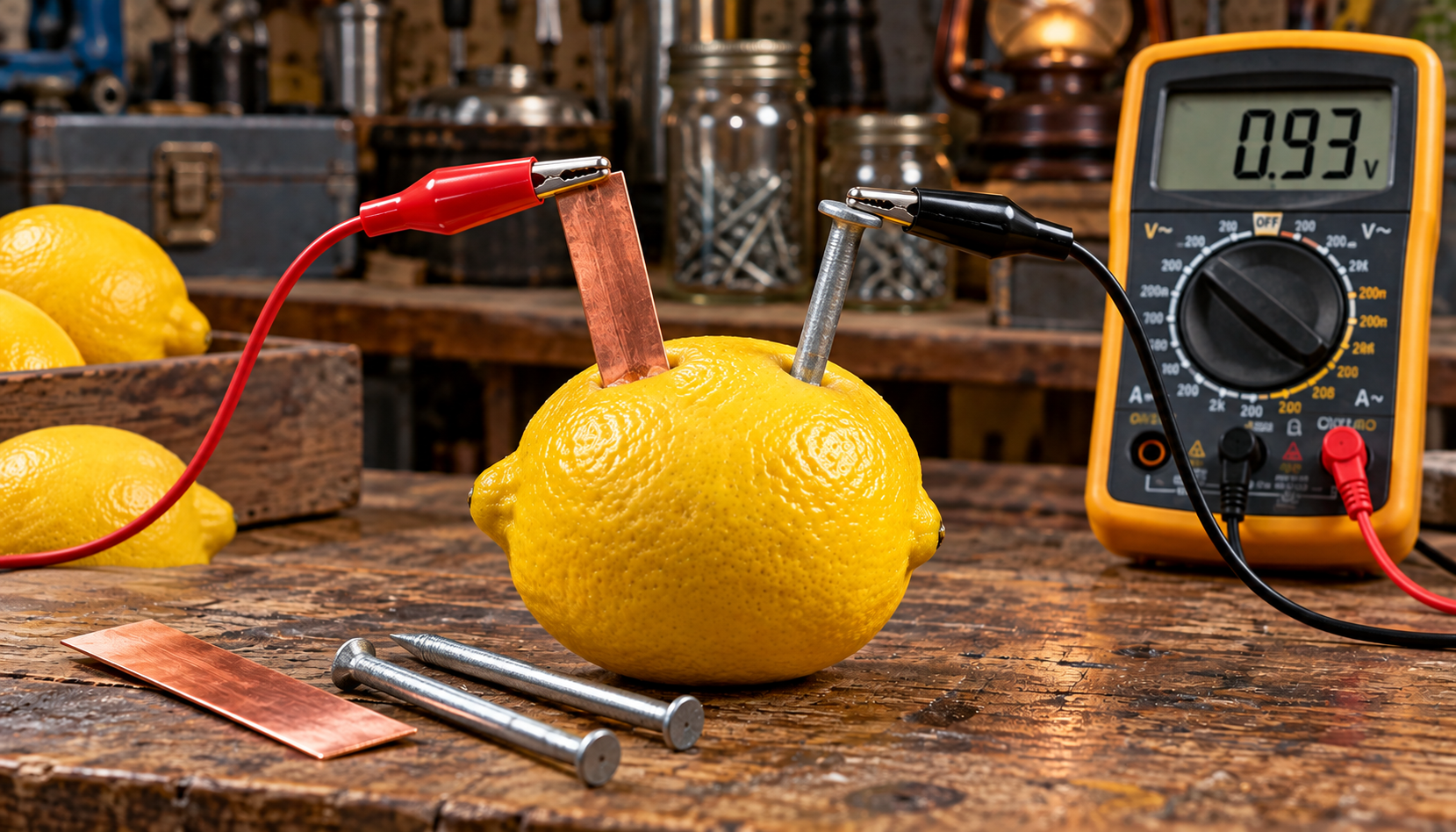
- Roll a lemon gently on the table to loosen its internal juices without breaking the skin.
- Insert one galvanized nail into the lemon.
- Insert one copper strip or bare copper wire into the opposite side.
- Make sure the two metals do not touch inside the lemon.
- Connect the multimeter's red lead to the copper and the black lead to the galvanized nail.
- Set the multimeter to DC voltage and record the reading.
You should normally see a measurable voltage, although the exact reading depends on the metals, lemon, and contact conditions.
STEP 2 — CONNECT FOUR LEMONS
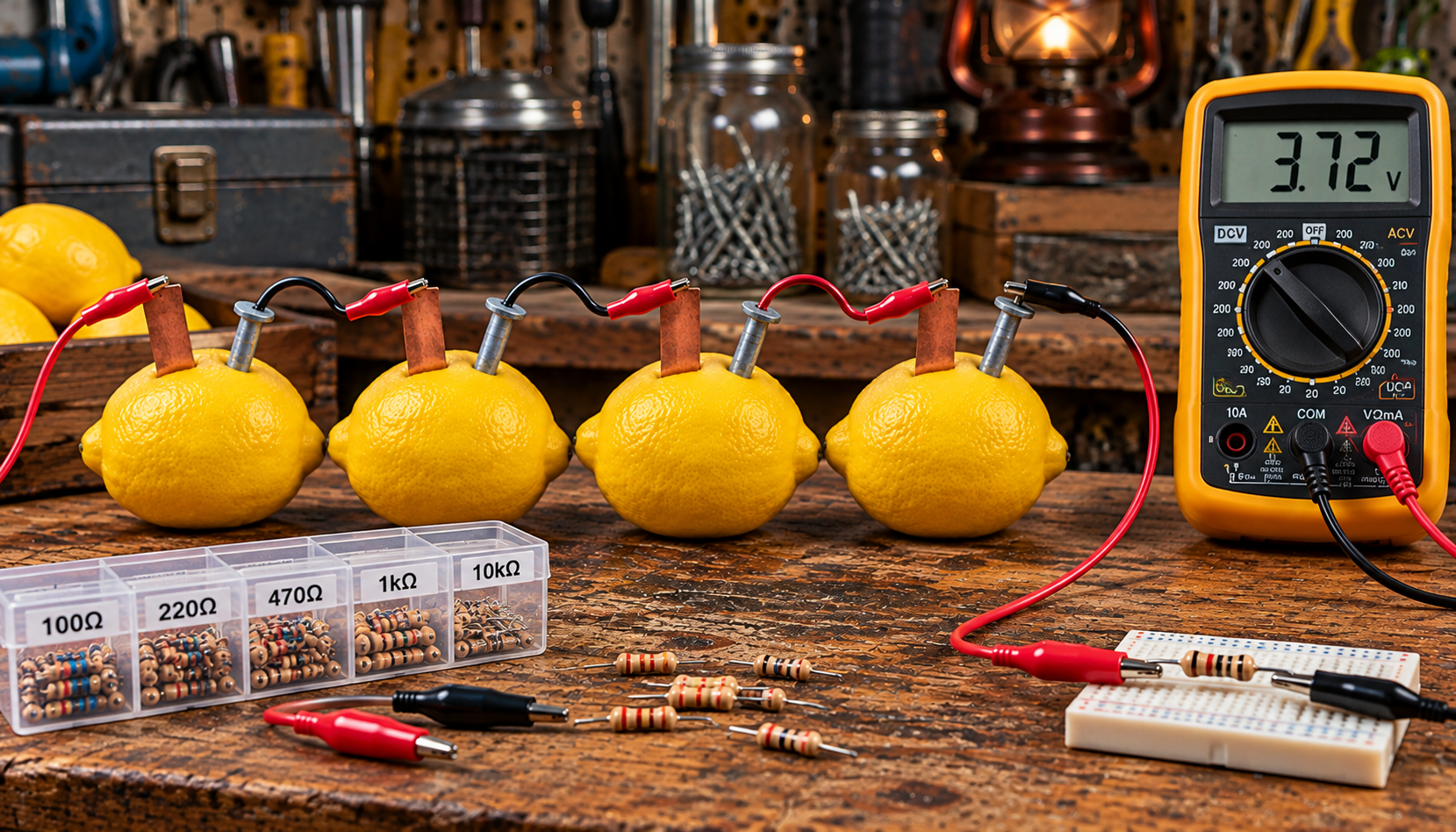
Build four identical lemon cells.
Connect the copper electrode of the first lemon to the zinc-coated nail of the second lemon. Repeat this connection between the second and third, and between the third and fourth lemons.
This is called a series connection. The voltages of the individual cells add together.
Measure the voltage across the two remaining unconnected electrodes: the zinc electrode at one end and the copper electrode at the other.
Question: Did the measured voltage increase approximately fourfold?

STEP 3 — MEASURE REAL POWER
Voltage alone doesn't tell us how much useful electricity the battery can deliver.
First, measure the open-circuit voltage with nothing connected except the multimeter.
Next, connect a 1,000-ohm resistor across the battery terminals. Measure the voltage across the resistor while it remains connected.
Calculate current using Ohm's law:
I = V / R
Calculate electrical power:
P = V² / R
With voltage measured in volts and resistance in ohms, power is calculated in watts.
Try different resistors if available. Record how the voltage changes under different loads.
ECHO-7 LABORATORY ANALYZER
Enter your measured voltages. The example values below are placeholders, not actual experiment results.
Current and power are calculated from the voltage measured across the resistor. Never connect the lemon battery directly to a phone.
WHAT'S REALLY HAPPENING?
The lemon juice acts as an electrolyte, allowing ions to move between two different metal electrodes.
The zinc coating on the galvanized nail undergoes an oxidation reaction, releasing electrons into the external circuit. Other chemical reactions occur at the copper electrode, which primarily provides a conducting surface.
The lemon is not creating energy from nothing. The battery converts chemical energy, principally associated with the electrode reactions, into electrical energy.
This is called a galvanic cell.
CAN IT CHARGE A PHONE?
A modern cellphone typically requires a regulated electrical supply and substantially more power than a small lemon battery can conveniently provide.
Even if several lemons produce enough open-circuit voltage, the voltage may collapse when a substantial load is connected.
Specialized circuits and many more cells could theoretically accumulate small amounts of energy in storage, but a few lemons and nails are not a practical cellphone charger.
Never connect the experiment directly to a phone.
OUR VERDICT
Does a lemon battery generate electricity? YES — the underlying electrochemistry is established science.
Can four lemons directly charge a cellphone? Not practically, and they should not be connected directly to one.
What will our experiment demonstrate? The difference between producing measurable voltage and delivering useful electrical power.
Our own measurements will be added after the experiment has been performed.
THE ALTERNATIVE ENERGY LAB
We Don't Just Ask If It Works. We Find Out Why.
Build it. Test it. Measure it. Share what you discover.