
🔥 HEAT INTO ELECTRICITY
Hot on One Side. Cold on the Other. Electricity in Between!
Can heat produce electricity without a motor, turbine, or moving parts?
Explore thermoelectric generators, temperature differences, and the surprising science of turning heat flow into electrical energy.
THE THERMOELECTRIC GENERATOR
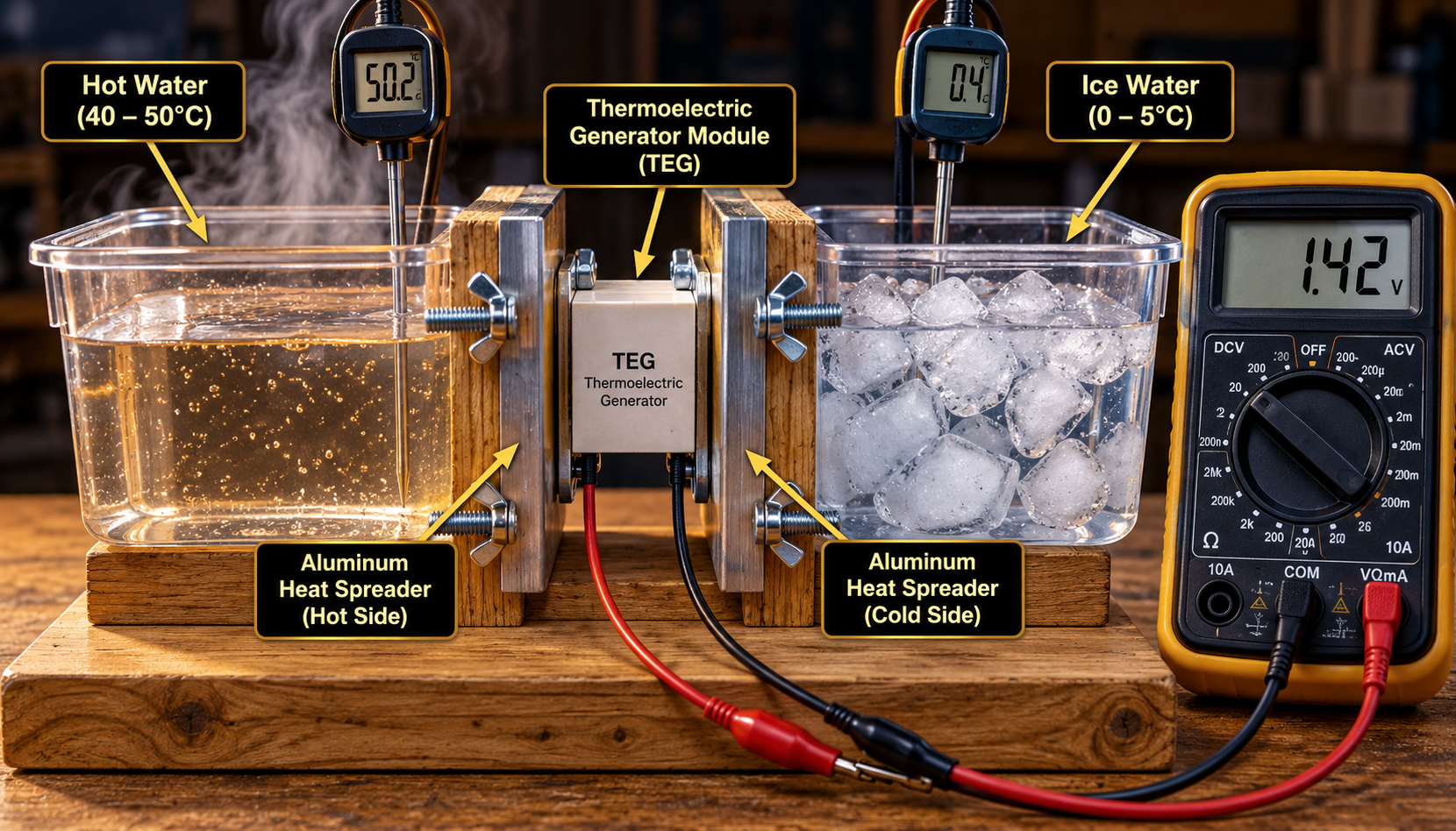
One Side Hot. One Side Cold. Electricity!
Concept illustration for educational purposes. The displayed temperatures and voltage are examples, not actual laboratory measurements. Build the thermal connections according to the instructions and module specifications.
THE POWER OF TEMPERATURE DIFFERENCES
Heat is all around us. It escapes from engines, wood stoves, industrial equipment, hot water pipes, and even our own bodies.
But can some of that energy be converted into electricity?
Thermoelectric generators use a scientific principle called the Seebeck effect. When the two sides of a suitable thermoelectric device are held at different temperatures, the device can generate electrical voltage.
The larger the temperature difference, the greater the potential voltage under otherwise similar conditions. Actual power output also depends on the device, electrical load, and heat transfer.
Our mission: Measure the heat difference. Measure the electricity. Discover the relationship.
EXPERIMENT 003
Can Hot Water and Ice Produce Electricity?
Imagine placing a small electronic device between something warm and something cold, then watching a multimeter register voltage without connecting a battery!
That's exactly what we're going to investigate.
WHAT YOU'LL NEED
- One thermoelectric generator module (TEG), preferably designed for power generation
- Two small, flat aluminum plates or heat spreaders
- One container of warm water
- One container of ice water
- Two thermometers or temperature probes
- Digital multimeter
- Connecting wires with alligator clips
- A resistor assortment for electrical load testing
- Optional: a small amount of thermal paste
Important: A purpose-built TEG is preferable to a common Peltier cooling module. Check the manufacturer's temperature limits before beginning.
BUILD THE EXPERIMENT
- Prepare one container of warm water and another containing ice water.
- Arrange the TEG between two flat metal heat spreaders so one side can be warmed and the other cooled.
- Keep the TEG and electrical connections dry. Use a stable arrangement that provides gentle, even contact without bending the module.
- Use warm water around 40–50°C (104–122°F) for the first test, provided it is within the module's ratings.
- Measure the temperature of both heat spreaders as close to the TEG surfaces as practical.
- Connect the multimeter to the TEG leads and select DC voltage.
- Record the voltage while the two sides are at different temperatures.
- Repeat using different safe temperature differences.
- Connect a suitable resistor across the output and measure voltage across that resistor.
- Calculate the electrical power delivered to the resistor.
For best results, the metal spreaders should make good thermal contact with the module. A small amount of thermal paste can help. Do not immerse the module unless the manufacturer specifically rates it for immersion.
RECORD YOUR RESULTS
| Hot Side °C | Cold Side °C | Difference °C | Voltage (V) |
|---|---|---|---|
| ___ | ___ | ___ | ___ |
| ___ | ___ | ___ | ___ |
| ___ | ___ | ___ | ___ |
CALCULATE ELECTRICAL POWER
When a resistor is connected across the generator, you can calculate the power delivered to that resistor:
Power (Watts) = Voltage² ÷ Resistance
For example, if you measure 0.5 volts across a 10-ohm resistor:
0.5 × 0.5 ÷ 10 = 0.025 Watts
That's 25 milliwatts. Not enough to charge a phone directly, but enough to demonstrate real electrical energy conversion.
Use the voltage measured with the resistor connected, not the open-circuit voltage, for this calculation.
QUESTIONS TO INVESTIGATE
- What happens when both sides are the same temperature?
- Does a larger temperature difference produce more voltage?
- What happens when the hot and cold sides are reversed?
- How much electrical power can the module deliver to a load?
- Could waste heat from a stove or engine be useful?
- What happens as the water temperatures become equal?
Difficulty: Beginner | Cost: Low to Moderate | Time: 45–90 Minutes
🤖 ECHO-7 EXPLAINS
"Interesting, isn't it? No moving parts, no spinning magnets, and no batteries. Just heat flowing from a warmer surface toward a cooler one."
"But don't misunderstand the experiment. We're not creating energy from nothing. We're converting a small portion of the energy flowing through the device into electricity."
"And remember, young scientists: if both sides reach the same temperature, our little generator has lost its driving force!"
MORE HEAT ENERGY EXPERIMENTS
☕ The Coffee Cup Generator
Can the heat from a fresh cup of coffee produce measurable electricity?
Body Heat Battery
Can the temperature difference between your skin and the surrounding air power a tiny electronic device?
Wood Stove Waste Heat
Investigate how thermoelectric generators might recover a small amount of electricity from heat that would otherwise be wasted. Any stove-mounted project requires purpose-built equipment and appropriate thermal protection.
The Hot Spring Challenge
Could naturally warm water and a cold mountain stream provide a useful temperature difference for electricity generation? Explore the theory and environmental considerations.
How Efficient Is a Thermoelectric Generator?
Compare electrical output with estimated heat input to investigate conversion efficiency and the limits of thermoelectric technology.
SAFETY FIRST
Begin with warm water rather than flames or boiling water. Hot surfaces and liquids can cause burns.
Keep water away from electrical connections and measuring instruments. Follow the temperature and mechanical limits specified by the TEG manufacturer.
Never attach an ordinary thermoelectric module directly to a fire, exhaust pipe, or wood stove.
Want to explore another energy experiment?
Use the site's Workbench navigation to return to the main experiment directory.
THE WORKBENCH RULE
Don't Just Believe It. Don't Just Doubt It. TEST IT!
Ask the question. Build the experiment. Measure the results. Share what you discover.
Alternative Energy Lab