💧 WATER, HYDROGEN & FUEL
Exploring the Energy Hidden in Chemical Bonds
Can electricity split water? Can hydrogen store energy? And how much energy does it take to produce a useful fuel?
Welcome to the Workbench where we investigate electrolysis, hydrogen, fuel cells, and the science behind water-powered energy claims.
HOW WATER ELECTROLYSIS WORKS
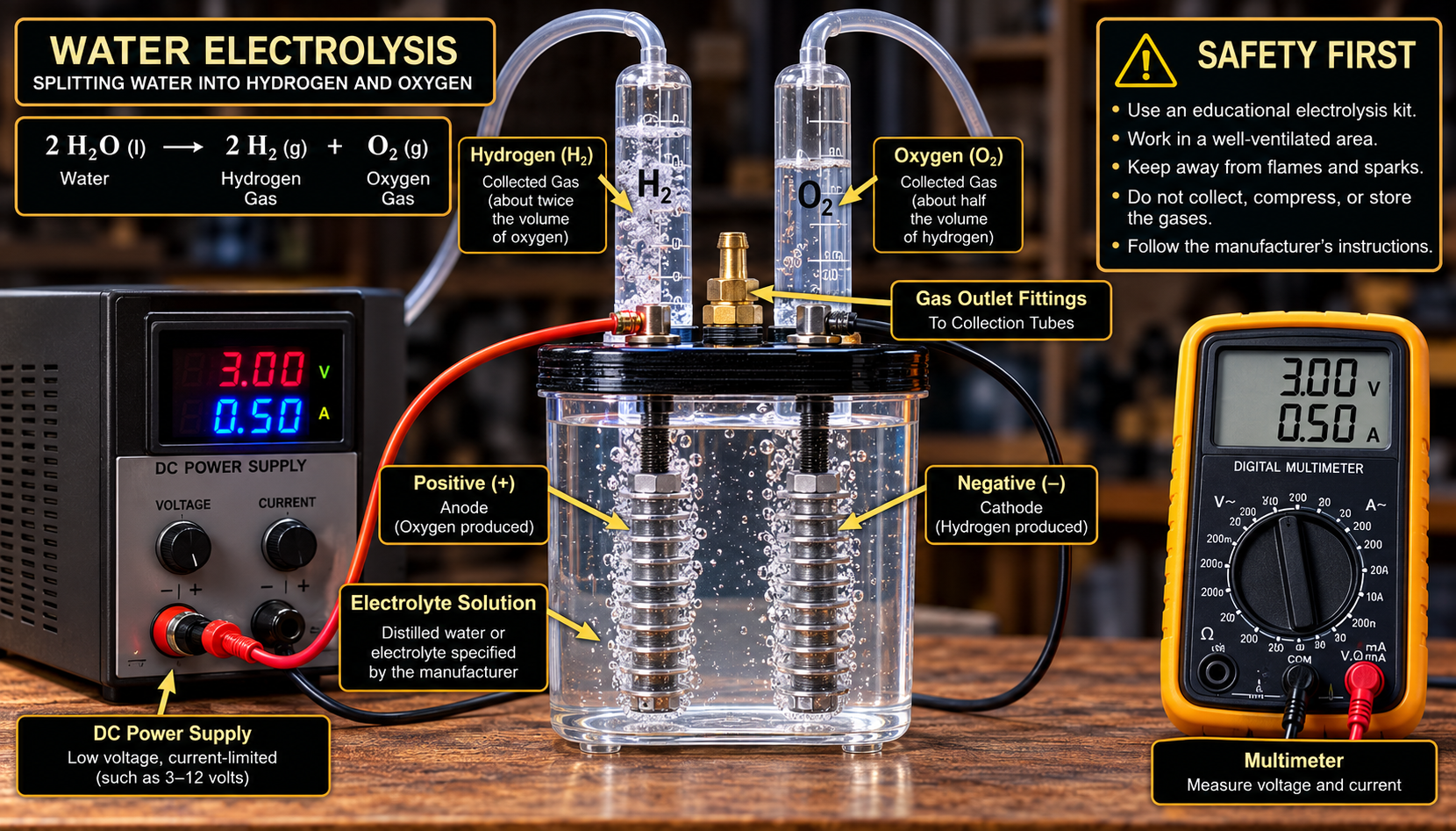
Electrical Energy In. Hydrogen Energy Stored.
Concept illustration only. Components, connections, and gas pathways are illustrative, not construction instructions. Use a commercially manufactured educational electrolyzer and follow its operating and safety instructions.
WATER IS NOT A FUEL
Water contains hydrogen, but water itself is not a source of free chemical energy. To separate hydrogen from oxygen, we must supply energy.
Hydrogen can then act as an energy carrier. Its stored chemical energy can be converted into electricity in a fuel cell or released as heat in a suitable controlled system.
The important question is not simply whether we can make hydrogen. It is how much energy we put into the process compared with how much useful energy we can recover.
Our mission: Measure energy input, investigate conversion losses, and understand what the results mean.
EXPERIMENT 004
How Much Electricity Does It Take to Split Water?
Electrolysis uses electrical energy to drive a chemical reaction that separates water into hydrogen and oxygen.
For this experiment, we'll use a small educational electrolyzer and measure its electrical input. We'll compare that input with the theoretical energy needed to produce hydrogen.
WHAT YOU'LL NEED
- A commercially manufactured educational water-electrolysis demonstration kit with manufacturer-provided safety instructions
- A low-voltage, current-limited DC power supply approved for the kit
- A digital multimeter
- Distilled water or the electrolyte specified by the kit manufacturer
- A stopwatch or timer
- Paper and pencil for recording measurements
- Optional: a second multimeter for simultaneous voltage and current measurements
Important: Use only a kit specifically designed for educational electrolysis. Do not improvise a hydrogen generator from household containers, saltwater, or unknown electrodes.
THE EXPERIMENT
- Read the educational kit's safety instructions and operating limits.
- Place the apparatus in a well-ventilated location away from flames, sparks, and electrical switching equipment that could ignite gas.
- Prepare the kit exactly as directed by its manufacturer.
- Connect the approved low-voltage power supply according to the kit instructions.
- Measure the voltage applied to the electrolyzer.
- Measure the current flowing through the device using the manufacturer's recommended measurement arrangement.
- Operate the kit only for its specified demonstration interval.
- Record the operating time, voltage, and current.
- Switch off the power supply and follow the manufacturer's shutdown procedure.
- Calculate the electrical energy supplied during the experiment.
Do not collect, compress, store, ignite, or deliberately mix the gases. If the kit produces gas, follow its specified ventilation and gas-handling instructions. Stop if the apparatus leaks, overheats, or behaves unexpectedly.
MEASURE YOUR ELECTRICAL INPUT
Electrical power is calculated using:
Power (Watts) = Voltage × Current
Electrical energy is:
Energy (Joules) = Power × Time (seconds)
For example, suppose an educational electrolyzer operates at 3 volts and 0.5 amperes for 60 seconds.
3 × 0.5 = 1.5 Watts
1.5 × 60 = 90 Joules
That means the electrical input was 90 joules during the demonstration, assuming voltage and current remained constant.
RECORD YOUR RESULTS
| Voltage (V) | Current (A) | Time (s) | Energy (J) |
|---|---|---|---|
| ___ | ___ | ___ | ___ |
| ___ | ___ | ___ | ___ |
QUESTIONS TO INVESTIGATE
- How much electrical energy did the electrolyzer consume?
- Did the voltage and current remain constant?
- What percentage of the electrical input might become stored chemical energy?
- Why do electrolyzers produce waste heat?
- Could solar or wind electricity be used to produce hydrogen?
- Why can't an engine power its own electrolyzer indefinitely using only the hydrogen it produces?
Measuring electrical input alone does not establish the electrolyzer's efficiency. To calculate actual conversion efficiency, we would also need a reliable measurement of hydrogen produced and a clearly defined energy basis.
Difficulty: Beginner with Supervision | Cost: Moderate | Time: 30–60 Minutes
🤖 ECHO-7 EXPLAINS
"Water is already a very stable chemical compound. If you want hydrogen, you must put energy into separating it from oxygen."
"And when you turn that hydrogen back into electricity or mechanical power, you'll lose some energy along the way. That's thermodynamics, not pessimism!"
"The question isn't whether hydrogen works. It does. The question is where the energy comes from and how efficiently we use it."
MORE WATER & HYDROGEN EXPERIMENTS
Solar-Powered Electrolysis
Can a small solar panel provide the electrical energy needed to operate an educational electrolyzer?
The Hydrogen Fuel Cell
Investigate how a commercial educational fuel cell converts hydrogen's chemical energy into electricity.
The HHO Efficiency Question
Examine claims about hydrogen-and-oxygen gas mixtures, electrical input, engine efficiency, and the energy balance of onboard electrolysis systems.
Can Water Power a Car?
Explore the difference between water as a source of hydrogen and hydrogen as an energy carrier. What energy source is actually moving the vehicle?
Comparing Energy Storage Methods
Compare hydrogen, batteries, and other methods of storing energy, including efficiency, cost, and practical limitations.
HYDROGEN SAFETY
Hydrogen is highly flammable, and hydrogen-oxygen mixtures can ignite violently. Never perform ignition demonstrations or use homemade gas-storage systems.
Do not use table salt as an electrolyte. Electrolysis of chloride-containing solutions can produce hazardous chlorine-containing substances.
Use purpose-built educational equipment under appropriate supervision and follow all manufacturer instructions.
THE WORKBENCH RULE
Don't Just Believe It. Don't Just Doubt It. TEST IT!
Ask the question. Build the experiment. Measure the results. Share what you discover.
Alternative Energy Lab