
Harvesting Water From Thin Air
Can we turn ordinary humid air into usable water?
ASK • PREDICT • BUILD • MEASURE • DO IT AGAIN • REPORT
The Big Question
Every day, enormous quantities of water exist in the atmosphere as invisible water vapor. Could we capture some of that water using a machine built from ordinary components?
The answer is yes. Atmospheric water generators already use cooling and condensation to extract moisture from air.
But how efficiently can we do it? How much water can we collect? And how much electricity will it cost?
Those are the questions we're going to investigate.
How Does It Work?
Think about a cold glass of iced tea on a humid Tennessee afternoon. Water droplets form on the outside of the glass. That water didn't leak through the glass. It condensed from moisture already present in the surrounding air.
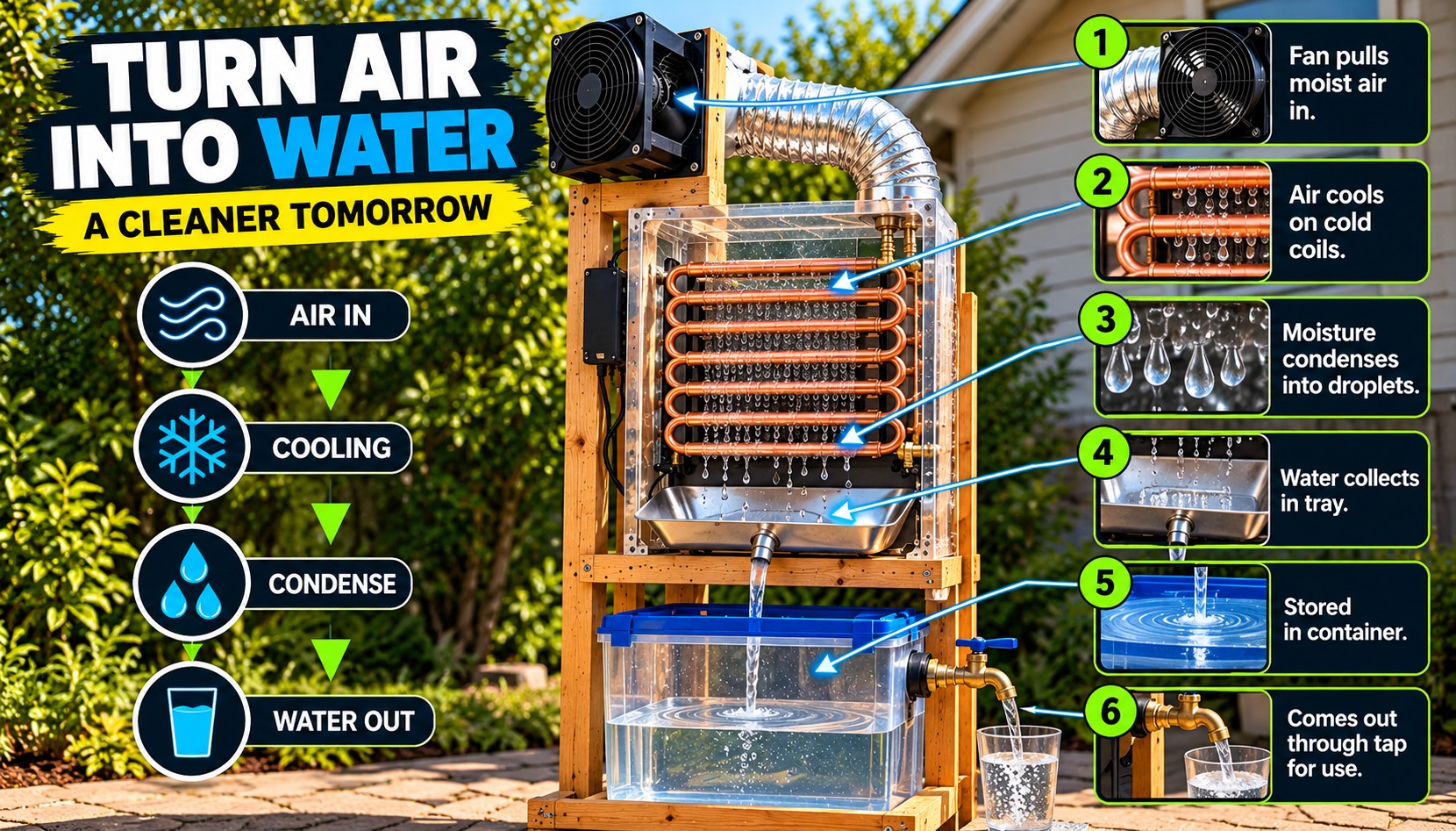
An atmospheric water generator applies the same principle using a controlled cooling system.
A fan draws humid air into the system.
Cold coils reduce the air temperature below its dew point.
Water vapor changes into liquid droplets.
Droplets drain into a collection tray.
Collected water flows into a suitable container.
We measure the water collected and electricity consumed.
Our First Experiment
Can a Household Dehumidifier Harvest Water Efficiently?
Instead of constructing a refrigeration system from scratch, we'll begin with a functioning household dehumidifier. It already contains the essential cooling components.
Equipment
- Household dehumidifier in safe working condition
- Plug-in electricity usage meter rated for the appliance
- Thermometer and humidity meter
- Measuring jug or graduated container
- Notebook or experiment log
- Clock or timer
Procedure
- Record the room temperature and relative humidity.
- Empty and clean the dehumidifier collection tank according to its instructions.
- Connect the appliance through a properly rated electricity meter.
- Operate the dehumidifier for a measured period, such as eight hours, following manufacturer guidance.
- Measure the quantity of collected water.
- Record total electrical energy used in kilowatt-hours.
- Calculate electricity consumed per liter of water.
- Repeat the experiment under different temperature and humidity conditions.
Important: Do not open or modify the appliance's refrigerant circuit or electrical components. Keep the appliance upright, ventilated, and operated according to its instructions.
Water Harvesting Efficiency Calculator
Enter your actual measurements or try hypothetical values to predict performance.
Calculations exclude equipment purchase, maintenance, filtration, and water treatment. For variable-power appliances, use the measured total kWh rather than estimating from a nameplate wattage.
Record Your Results
| Test | Temperature | Humidity | Hours | Water (L) | Energy (kWh) |
|---|---|---|---|---|---|
| 1 | _____ | _____ | _____ | _____ | _____ |
| 2 | _____ | _____ | _____ | _____ | _____ |
| 3 | _____ | _____ | _____ | _____ | _____ |
For consistent comparisons, record the appliance settings, location, starting conditions, and any changes in humidity during the test.
Is the Collected Water Safe to Drink?
No — not without appropriate treatment and verification.
Water collected by an ordinary dehumidifier may contain airborne contaminants, microorganisms, or substances introduced by coils, trays, tubing, and storage containers.
Our initial experiment is for measuring water production only. Do not drink the collected water or use it for food preparation.
Producing potable water requires equipment designed for that purpose, suitable treatment, sanitary storage, and appropriate water-quality testing.
What About Solar Power?
Could we operate our atmospheric water generator using solar energy?
Potentially, yes. However, the solar array, battery storage, inverter, and appliance must all be appropriately sized for the actual energy demand and startup requirements.
Our first job is to measure how much electricity it takes to produce one liter of water. Only then can we realistically design a solar-powered system.
Questions Worth Investigating
- Does warmer, more humid air improve water production?
- How does the energy cost compare with other water sources?
- Can we reduce energy use through better airflow or heat exchange?
- Could waste heat from the cooling system serve another purpose?
- Could a solar-powered system be practical for emergency water collection?
Lab Verdict: SUPPORTED
Scientific principle: Proven.
Practical performance: Depends on temperature, humidity, equipment efficiency, and electrical consumption.
Drinking-water suitability: Not established by condensation alone.
The challenge isn't whether atmospheric water collection works. The challenge is discovering when it works efficiently enough to be useful.